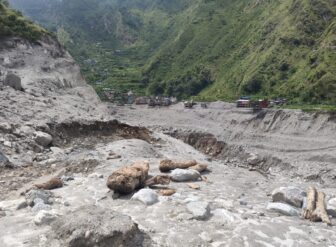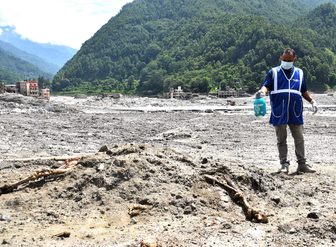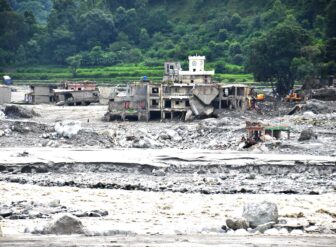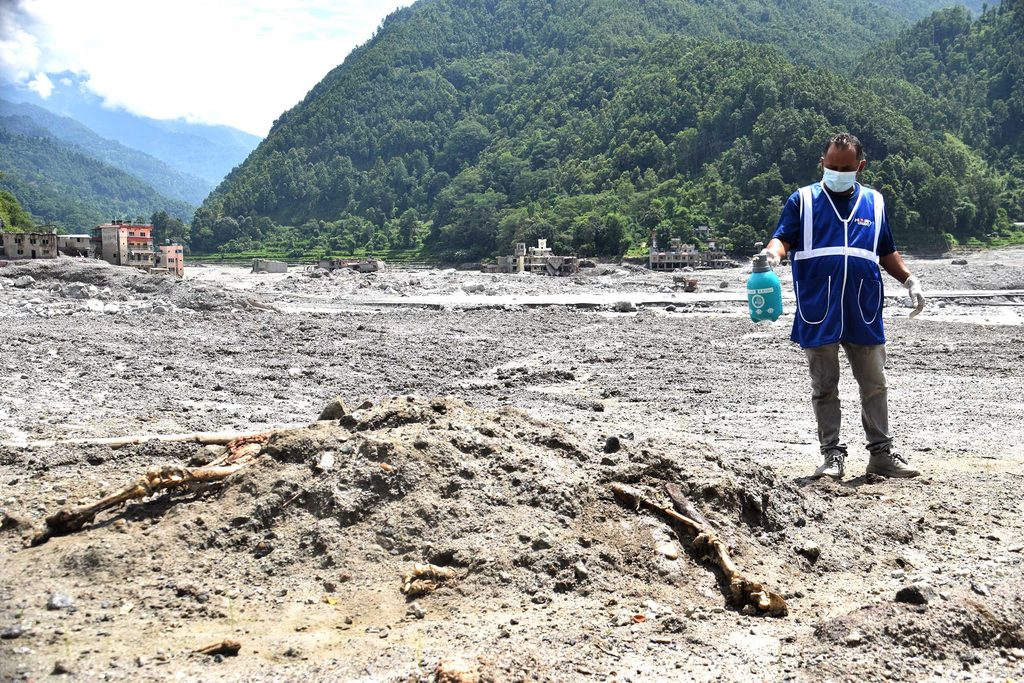
The Bhotekoshi flood, described as a “Himalayan tsunami,” has claimed the lives of 1,410 people, while 5,130 others remain missing. Search and rescue operations for those still unaccounted for are continuing, while those injured in the disaster are receiving treatment. With such a massive loss of life and property, the disaster is being described as the largest Himalayan tsunami Nepal has experienced so far.
Nepal, a country dominated by the high Himalayas, has experienced similar disasters in the past. On May 5, 2012, (23 Baisak 2069 BS) a massive flood occurred in the Seti River after an ice-rock mass fell from the Annapurna IV region of Kaski. The resulting flood swept away the entire Kharapani settlement in Machhapuchhre Rural Municipality, killing 72 people.
Similarly, on October 14, 2014, (28 Ashoj 2071 BS) an avalanche and snowstorm struck the Thorong Pass area along the world-famous Annapurna trekking route. Forty-three foreign tourists and Nepali nationals who were trekking in the area lost their lives. On August 2, 2022, (17 Saun 2079 BS) the Jure landslide and subsequent flooding of the Bhotekoshi River in Sindhupalchok killed 145 people.
Rising global temperatures are making Nepal’s Himalayan region increasingly unstable. As a result, the frequency of disasters such as Himalayan tsunamis, glacial floods and landslides appears to be increasing. Nepal is facing serious challenges in dealing with such disasters despite making only a negligible contribution to the global rise in temperatures.
It has now been a week since Nepal sought a meaningful response from the Fund for Responding to Loss and Damage under the United Nations Framework Convention on Climate Change. Nepal has called for international support to address the loss and damage caused by climate-related disasters.
Nepal sent a letter to the Fund for Responding to Loss and Damage on September 1. In its response, the Fund stated that its board had been advised to consider various options within the limits of its existing mandate, structure, policies and procedures.
Regarding the Bhotekoshi Himalayan tsunami, National Geographic reported that a massive mass of glacier ice and rock covering an area of about two square kilometres from the Langtang Himalayan region fell into the valley below. The event has also been linked to the impacts of climate change.
Nepal’s carbon emissions are extremely low not only compared with countries with high levels of carbon emissions but also in comparison with the global average. While the global average carbon emission is estimated at 4.67 tonnes per person per year, Nepal’s per-capita emissions are only about 0.54 tonnes. Nepal’s contribution to greenhouse gas emissions is therefore minimal. This is why Nepal should continue to raise its voice for compensation and international support for climate-related loss and damage.
Nepal became a party to the United Nations Framework Convention on Climate Change in 1994.
During the Earth Summit held in Rio de Janeiro, Brazil, in 1992, Nepal signed the Convention on Biological Diversity. The convention covers issues including the conservation of biological diversity, the sustainable use of its components, and the fair and equitable sharing of benefits arising from the use of genetic resources.
Nepal’s forest coverage, which stood at around 40 percent in 2000, has now increased to 46 percent. Nepal has also maintained that it has contributed to reducing greenhouse gas emissions through the expansion and protection of forest areas. Government officials say that community forestry and implementation of the national REDD strategy have produced positive results.
Nepal has not only maintained low carbon emissions but has also been actively working to address climate change and maintain environmental balance. The country has given priority to climate-related issues not only through the Millennium Development Goals and Sustainable Development Goals but also by allocating resources for climate action in the national budget.
Nepal’s own carbon emissions are negligible, yet its Himalayan region is warming and increasingly experiencing climate-related disasters. In this context, the demand for international support and compensation for the losses caused by the Bhotekoshi flood can be considered an important part of Nepal’s call for climate justice.
Prime Minister Balen Shah is scheduled to attend the United Nations General Assembly. Preparations are also underway to raise the issue of climate justice at the meeting. In the context of the Himalayan tsunami that struck Rasuwa on August 26, Nepal needs to use the international platform effectively to present its case.
For this, the Prime Minister’s key priority should be to travel to New York with thorough preparation, backed by scientific evidence, accurate assessments of the damage and clear documentation of the links between climate change and the disaster.